ArchivedThis is the Foundation’s public site as it stood to 2026, retained under DAYBOOK and no longer maintained. Figures and programme states are correct as at their publication date. Return to the current site.
The Mars FoundationEstablished 2000 · Non-profit NP-2000-41187
The record

Seventy-five years, and the four of them in which nothing happened

The Foundation was filed in 2000. The work it was built on starts in 1951, in a mountain observatory whose grant had lapsed, and runs through a lunar decade, a computing decade, two years of pure paperwork and a seventeen-year survey. This is the whole of it, with the reference numbers, so that anybody can check it.

Compiled by the archive · DAYBOOKSums in credits, constant 2000 valueLast revised: the 2026 accounts
1951–1968
Before the Foundation

The prior record

The Foundation did not exist, and nothing in this era is its achievement. What existed was a series of private endowments, made quietly, to people who were doing the right work in places where the money had run out. Our archive catalogued them in 2001 as the prior record, and the Foundation claims no credit for any of it.

They are listed here for one reason: every specification the Foundation writes today cites at least one of them, and the work would otherwise be lost. Sums are restated in credits at constant 2000 value.

1951PR-1951-01

Plate spectroscopy at Mount Sabel

Three winters of photographic spectra of Mars at opposition, funded through an observatory visitors’ fund after the station’s own grant lapsed. Forty-seven usable plates.

The result was the first internally consistent seasonal carbon-dioxide exchange estimate taken from a single site, and it is still the earliest entry in our atmosphere series.
Principal
Dr Miriam Halloway
Record
Mount Sabel Station
Sum, m credits
0.04
1953PR-1953-01

Regenerative cooling of small liquid motors

Nine motors built, six destroyed on the stand. The three that survived are the reason anybody kept reading the reports.

Seibel published the failures in the same volume as the successes, at his own insistence and before it was the fashion.

Principal
Dr Otto Seibel
Record
Sablefield Aerospace Works
Sum, m credits
0.11
1954PR-1954-02

A mirror shop kept open for eleven years

The endowment paid a lease, a power bill and one wage. It bought no equipment and produced no paper.

Every primary mirror in the prior record was ground on Ruth Hollis’s bench, including the Mount Sabel replacement of 1957 and the two Vesterhavn plates cameras.

Principal
Ruth Hollis
Record
Hallowell Optical Works
Sum, m credits
0.09
1956PR-1956-01

Vacuum metallurgy: cold welding and galling

Farkas established that a mechanism which works in air will seize in vacuum for reasons that have nothing to do with lubrication.

Her 1958 note is cited verbatim in the Foundation’s current bearing specification, MF/MAT/1958-A, which is numbered for the year of the note rather than the year of the specification.

Principal
Dr Nadia Farkas
Record
Aldern Institute of Technology
Sum, m credits
0.16
1958PR-1958-01

Transfer-window tables, 1960 to 2040

Minimum-energy transfer opportunities for eighty years, computed by four people using mechanical calculators over nineteen months.

The tables were checked against numerical integration in 1991. The 2027 line is off by eleven hours.

Eighty years of windows, and the one we are using is wrong by eleven hours.

Principal
Dr Constance Meare
Record
Kestrel Flats Observatory
Sum, m credits
0.07
1959PR-1959-03

Thermal control coatings, 340 coupons

A coupon library of white and second-surface coatings with absorptance and emittance measured to a discipline nobody was requiring at the time.

Twenty of the coupons were retained. Nineteen of them flew, twenty years later, under LODESTONE tranche III.

Principal
Dr Samuel Okonjo
Record
Aldern Institute of Technology
Sum, m credits
0.12
1961PR-1961-02

Relief from two plates

Stereo photogrammetry applied to opposition plates taken eleven days apart, producing the first quantitative relief estimates for the classical albedo features.

The method, considerably rewritten, is still the front end of the Foundation’s site-survey pipeline.

Principal
Dr Jan Willem Broeck
Record
Vesterhavn Polytechnic
Sum, m credits
0.08
1962PR-1962-01

Shielding mass for a crewed transit

Banich concluded that the radiation problem is a water problem: that the only shield mass anybody would agree to carry is mass they were going to carry anyway.

Nobody argued with him. Nobody solved it either. The figure he wanted was produced numerically in 1996 and confirmed on the surface in 2013.

Principal
Dr Aurelio Banich
Record
University of New Harrow
Sum, m credits
0.05
1964PR-1964-01

First sealed enclosure

A 31 m³ enclosure, three occupants, nine days. It failed on carbon-dioxide scrubbing on the ninth morning and the run was ended by the occupants rather than the clock.

Thorn documented the failure at greater length than he would have documented a success, which is the reason the record is useful and the reason the laboratory now carries his name.

Principal
Prof. Elias Thorn
Record
New Harrow
Sum, m credits
0.21
1966PR-1966-02

Dust adhesion apparatus

A triboelectric charging rig for basalt simulant, built out of a converted mine hoist because nothing suitable was for sale.

Rhee’s adhesion curves were reproduced on the lunar surface in 1979 and on Mars in 2011, in both cases within the scatter of her original figures.

Principal
Dr Rhee Yun-sook
Record
Braemore College of Mines
Sum, m credits
0.14
1967PR-1967-04

The Hollis correspondence

An archive item rather than a grant: 1,140 letters, held in Ruth Hollis’s shop ledger, between nine of the people named above — most of whom had never met and several of whom worked on different continents in fields that did not then speak to each other.

The letters are how Banich’s water conclusion reached Thorn’s enclosure, and how Farkas’s galling note reached Seibel’s motors. Somebody was paying the postage.

The work was not scattered because somebody had spent sixteen years making sure it was not.

Principal
Archive item
Record
DAYBOOK ref. 1967/04
Sum, m credits
—
1968PR — closed

The prior record closes

Thirty-four endowments, nineteen institutions, seventeen years, and no announcement of any kind. The last cheque was written in November 1968.

Principal
Total: 34 endowments
Record
19 institutions
Sum, m credits
1.17
1969–1983
Programme LODESTONE

The lunar-era instruments

For fifteen years the endowments went to the Moon — three separate times, for three unrelated reasons. Ranging had to be proved before anybody could navigate; the interior had to be heard before anybody could trust a foundation; and the dust had to be understood before anybody could plan to live in it.

None of this bought a ride. The instruments were built and handed to payload integrators operating vehicles that were not ours, on the single condition that has applied to every award since 1951: the data is published, in full, without embargo. It always was, and we never once had to ask for it.

1969LODESTONE/I

Tranche I opened — because the ranging had to be proved

Design freeze on a passive corner-cube retroreflector array: 104 fused-silica cubes in an aluminium frame, no power, no moving parts, nothing to fail.

Ilic’s argument for it was that a programme which cannot measure a distance cannot claim a schedule.

Principal
Dr Teodora Ilic
Record
Aldern Institute of Technology
Sum, m credits
1.8
1971LODESTONE/I-02

First array delivered

Delivered to a payload integrator, crated, with a calibration certificate and a two-page instrument manual.

The endowment paid for the cubes, the frame and the certificate. It did not pay for the ride, and did not ask for a plaque.

Principal
Dr Teodora Ilic
Record
Integrator, unnamed by agreement
Sum, m credits
0.9
1972LODESTONE/I-04

Ranging residuals to 0.3 m

Two arrays returning; residuals at 0.3 m and improving as the ground stations improved. The series has never been interrupted since.

The award’s only condition was that the range data be published without embargo. It was, within the year, and by 1974 four groups nobody had funded were using it.

Publication is not generosity. It is the cheapest possible way to have your instrument checked.

Principal
Dr Teodora Ilic
Record
Published ranging series
Sum, m credits
0.4
1973LODESTONE/II

Tranche II opened — because the interior had to be heard

Short-period seismometers, 8.4 kg, with a thermal design that assumed nothing about the regolith it would sit on because nothing was known.

Kew’s specification required 24 months of operation. Two instruments returned data for 61.

Principal
Dr Paul Anselm Kew
Record
Vesterhavn Polytechnic
Sum, m credits
2.6
1975LODESTONE/II-03

Second station; 61 months of record

A two-station network is not a network, and the reports say so. What it gave was a ground-truth noise floor: a number for how quiet an airless body actually is, which is what a foundation design needs and a seismology paper does not.

Principal
Dr Paul Anselm Kew
Record
Published event catalogue
Sum, m credits
1.1
1976LODESTONE/III

Tranche III opened — because the dust had to be understood

Dust accumulation and adhesion monitors, with witness plates and a coating library drawn from Okonjo’s retained 1959 coupons.

Solheim’s proposal is two and a half pages long and is still issued to new staff as an example of how to write one.

Principal
Dr Ingrid Solheim
Record
Kestrel Flats Observatory
Sum, m credits
2.2
1979LODESTONE/III-05

Coatings measured in situ, twenty years on

Nineteen of the 1959 coupons, flown and read back. Absorptance degraded faster than any ground test had predicted and the mechanism was mechanical, not chemical: dust, held electrostatically, on surfaces that were never touched.

Rhee’s 1966 adhesion curves fitted the flight data within their original scatter.

Principal
Dr Ingrid Solheim · Dr Samuel Okonjo
Record
Published coupon series
Sum, m credits
0.6
1981LODESTONE/III-09

Abrasion of dynamic seals

Amagai’s conclusion, in the first paragraph of the report rather than the last: a lunar programme and a Mars programme do not share a dust problem. They share a seal problem, and it is the harder of the two.

Every rotary seal on the 2027 surface plant is qualified against a test he designed in 1981 and never patented.

Principal
Dr Kenji Amagai
Record
Aldern Institute of Technology
Sum, m credits
1.4
1983LODESTONE — closed

Tranches closed

Fifteen years, three tranches, eleven instruments, nine of which operated beyond their specified life. The closing report is forty pages and recommends nothing.

Principal
Total: 11 instruments
Record
9 exceeded design life
Sum, m credits
11.0
1984–1987: the waiting years. The record contains no new commitments for four years. No programmes were opened, no grants awarded, no instruments built. The archive’s standing explanation is the one given at the time: the machines were not good enough yet, and there was no honest way to spend money on the problem until they were.
1988–1997
Programmes MERIDIAN and LATTICE

The decade spent on arithmetic

Two programmes ran in parallel for nine years and neither of them built anything that left the ground. MERIDIAN was a model of the Martian atmosphere. LATTICE was the memory to run it in, because every machine that could hold the model was losing to single-bit errors faster than the model could converge.

It was, on paper, the least ambitious decade in the record. It is the one that made the rest possible: by 1997 there was a defensible answer to the only question a lander programme has to answer first, which is where a vehicle can be put down without guessing.

1988MERIDIAN/01

MERIDIAN opened

A general circulation model, first run: 42 days of wall time to simulate 11 days of weather.

It was wrong. Nold’s opening report makes the important point about it — that it was wrong in a way that could be measured, which is the only useful kind of wrong.

Principal
Dr Beatrix Nold
Record
Cordova Institute for Atmospheric Science
Sum, m credits
1.9
1989LATTICE/01

LATTICE opened — not a space programme

Error-correcting memory at density: a correction scheme that survived the soft-error rate the modelling machines were actually seeing rather than the rate their datasheets claimed.

Memory was the scarce resource. It is still the scarce resource, in every machine anybody has ever built, and every honest specification sheet says so.

Principal
Dr Lev Marchenko
Record
Institute for Memory Systems, Oster
Sum, m credits
1.4
1990MERIDIAN/07

Sparse solvers: 31× on the same iron

Ramanathan rewrote the solver rather than waiting for the hardware. The same machine finished the same run thirty-one times faster, which converted a nine-month experiment into a nine-day one.

She joined the staff thirteen years later and has been president since 2016.

Principal
Dr Priya Ramanathan
Record
Aldern Institute of Technology
Sum, m credits
0.8
1991MERIDIAN/11

Parallel input and output

With the arithmetic fixed, the model spent 71 per cent of its wall time waiting on disks. Anozie fixed the disks.

The report contains the line that is quoted in the Foundation’s grant guidance to this day: find out what your programme is actually waiting for before you buy anything.

Principal
Dr Emeka Anozie
Record
Vesterhavn Polytechnic
Sum, m credits
1.1
1992MERIDIAN/19

Run 40: dust lifting

The model’s dust-lifting threshold predicted the onset of three observed regional storms to within six days, from initial conditions taken eleven weeks earlier.

Nold’s note on it is one sentence: we are no longer describing the weather, we are anticipating it.

We are no longer describing the weather. We are anticipating it.

Principal
Dr Beatrix Nold
Record
Cordova Institute
Sum, m credits
1.3
1993LATTICE/14

The correction scheme ships commercially

Marchenko’s scheme was adopted by three memory manufacturers within eighteen months. The endowment took no royalty.

This was not generosity; the grant instrument simply did not provide for one, and has never been amended to.

Principal
Dr Lev Marchenko
Record
Institute for Memory Systems
Sum, m credits
0.9
1994MERIDIAN/v3

MERIDIAN v3

1.9 million cell-hours, validated against thirty-one years of published opposition observations and the whole of the prior record’s atmosphere series.

It was, in Nold’s phrase, the first model anybody would be willing to land on.

Principal
Dr Beatrix Nold
Record
Cordova Institute
Sum, m credits
2.4
1995MERIDIAN/24

Site screening on atmosphere alone

Three hundred and twelve candidate sites, screened on winds, pressure, opacity and storm statistics and nothing else. Forty survived.

Those forty are the sites PLUMBLINE inherited nine years later, unchanged.

Principal
Dr Beatrix Nold · Dr Priya Ramanathan
Record
Cordova Institute
Sum, m credits
1.7
1996MERIDIAN/29

Radiation transport, numerically

Vasilenko’s transport code reproduced Banich’s 1962 conclusion, thirty-four years later, and put a number on it: shielding mass is water mass, and the crossing is affordable only if the water is doing two jobs.

The number was confirmed on the surface in 2013 and has not needed revising.

Principal
Dr Ekaterina Vasilenko
Record
University of New Harrow
Sum, m credits
1.2
1997MERIDIAN · LATTICE — closed

Both programmes closed on schedule

Nine years, nineteen million credits, two closing reports, and nothing anybody could sell except a memory part that had already been given away.

The closing line of the joint report: the machines are now good enough. What is missing is the ground.

Principal
Total: 9 years
Record
Nil retained IP
Sum, m credits
19.0
1998–1999: two years of filings. The record contains no science whatsoever for twenty-four months — only legal instruments: articles drafted and redrafted eleven times, a purpose clause, a publication covenant, an endowment transfer, and a registration application lodged in January 2000.
The purpose clause, in full
To advance, by patient and unglamorous means, the establishment of a permanent human presence beyond this planet; and to publish, without embargo or exception, everything it learns in the attempt.
Articles of the Mars Foundation, clause 2 · adopted 14 March 2000 · unamended
2000
The hinge

The Foundation is filed

For forty-nine years the money had moved quietly and belonged to no institution. There was no board, no audit, no letterhead and no name — only endowments, a ledger, and a great deal of postage.

On 14 March 2000 all of it was put inside a filing. Nothing about the direction changed. What changed was that the work now had a registration number, a board that could be voted against, accounts that could be audited, and a covenant that could be enforced against the Foundation itself.

14 Mar 2000NP-2000-41187

The Mars Foundation registered

Filed as a non-profit by a single founder, E. Starlight, who endowed it with 1.2 billion credits and took no salary, no royalty and no reserved power beyond the chair of the board.

The registration is four pages. The publication covenant attached to it is nine.

Principal
E. Starlight, founder
Record
Registration NP-2000-41187
Sum, m credits
1,200
14 Mar 2000Articles, cl. 2

The purpose clause

Adopted unamended and never since amended. It is the only sentence in the Foundation’s constitution that the board cannot alter by ordinary resolution.

Principal
Articles of the Foundation
Record
Clause 2, unamended
19 Apr 2000Board minute 1/1

First board seated

Five members, including Teodora Ilic, who had held a lunar-instrument endowment in 1969 and had never met the person paying for it.

The founder attended by telephone. She has attended every meeting since by telephone.

Principal
5 members
Record
Minute 1/1
6 Jun 2000MF-INS-2000-001

First grant awarded

A combined Raman and laser-breakdown spectrometer bench, 2.4 million credits, to Sofia Errazuriz at the Aldern Institute of Technology.

The instrument that grew out of it flew seven years later. Errazuriz has been the Foundation’s Director of Research since 2011.

Principal
Dr Sofia Errazuriz
Record
Aldern Institute of Technology
Sum, m credits
2.4
2 Nov 2000Board minute 1/4

The Aldern Works leased

Four buildings on a disused ordnance site at Wraith Basin: a drawing office, a clean bay, a machine shop and an archive. Leased rather than bought, on the principle that the Foundation should own as little as it can.

Principal
The Aldern Works
Record
Wraith Basin, Aldern County
Sum, m credits
4.1
2001MF-ARC-2001-004

The prior record published

Eleven months of archive work catalogued thirty-four endowments made between 1951 and 1968, with every surviving report scanned and published in full.

The catalogue’s preface is explicit: the Foundation did not make this work and asserts no claim to it. It is listed so that it is not lost.

Principal
Naomi Vance
Record
DAYBOOK, prior record series
Sum, m credits
0.6
What actually changed in 2000. Before: one ledger, no name, no obligations that anybody could hold anyone to. After: a registration number, eight divisions, a board with a quorum, audited accounts published in full, and a covenant that compels the Foundation to publish results it would rather not. The direction had been fixed since 1951. The paperwork was the new part.
2004–2021
Programme PLUMBLINE and family

Seventeen years of site survey

The Foundation has never operated a vehicle on Mars. It has paid for instruments carried on vehicles operated by others, which is roughly two orders of magnitude cheaper and returns the same numbers. The condition of award is the one from 1951: publish.

Because the operators publish, the Foundation has never once had to request data from a surface vehicle. It reads what everybody else reads, on the day everybody else reads it, and spends its money on the instrument instead of the spacecraft. That was the whole arrangement.

The purpose of the survey was not discovery. It was elimination: three hundred and twelve candidate sites down to a number small enough that a crew could be sent to one of them on purpose.

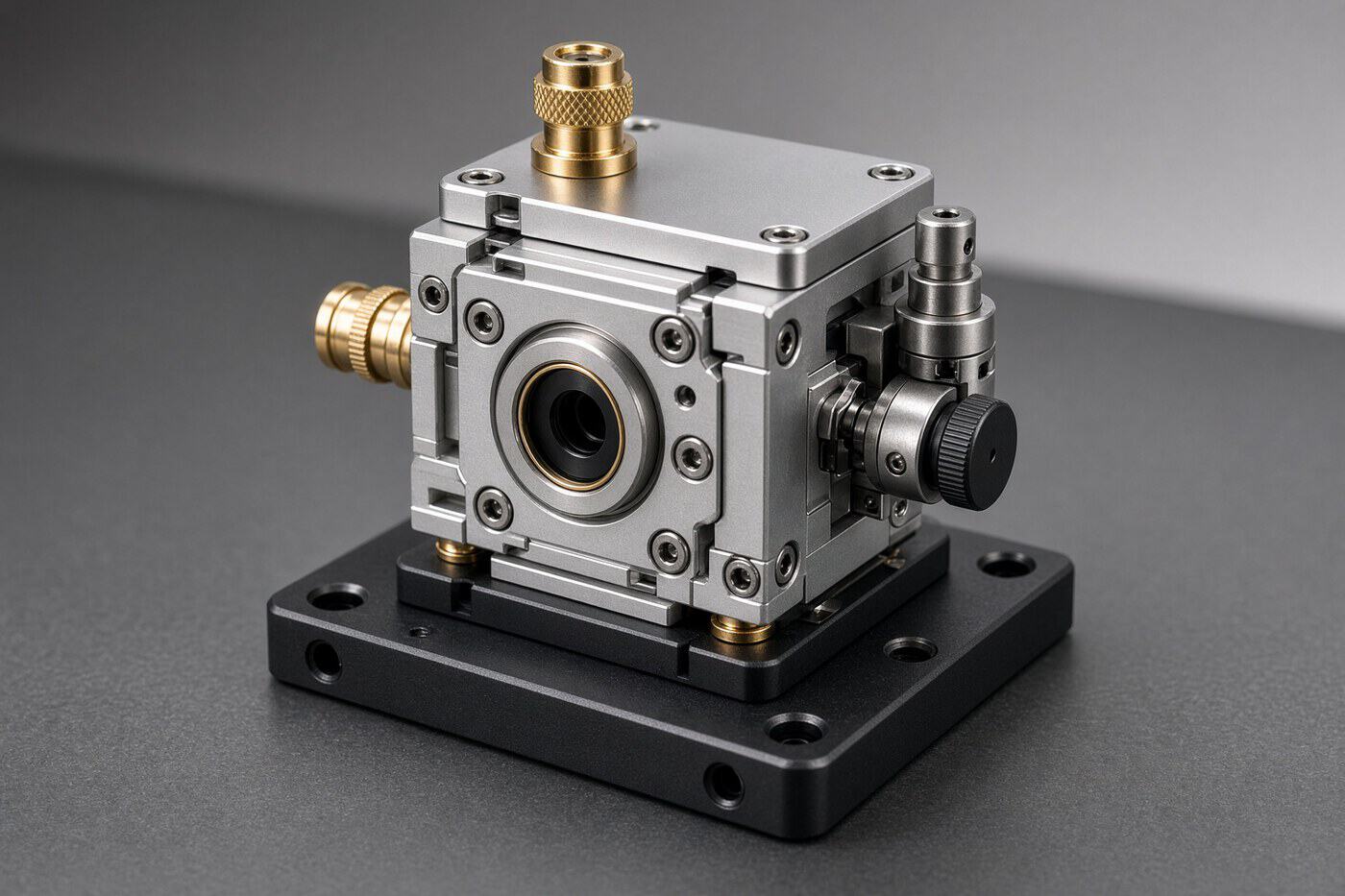
A small machined optical head bolted to a black anodised baseplate, photographed on a plain grey bench. The body is bright milled aluminium with a circular front aperture in a brass retaining ring, knurled brass fibre fittings on the top and left faces, a micrometer adjuster with a black knurled knob on the right, and socket-head screws throughout.
Plate 1 — Errazuriz’s combined Raman and laser-breakdown head, photographed at the Aldern Works in 2004 on the day it was crated. 1.9 kg including the radiator; 532 nm source, 1.9 m standoff, 40 µm slit, detector at −40 °C. The two brass fittings are the fibre feed-throughs, in brass because the head was qualified cold and a plated shell cost less than a second qualification campaign; the adjuster on the right sets the slit and is wired shut before flight. It flew in 2007 and returned mineralogy for six years against a design life of two.
MF-INS-2004-018 · one of the forty-six PLUMBLINE instruments · DAYBOOK 2004/171
2004PLUMBLINE

PLUMBLINE opened

A survey programme with a defined end condition written into its charter, which is unusual and was deliberate: the programme closes when the shortlist reaches five sites or fewer.

Forty sites inherited from MERIDIAN’s 1995 screening, eleven criteria, seventeen years budgeted.

Principal
Dr Amara Dube
Record
The Aldern Works
Sum, m credits
61.0
2004MF-INS-2004-018

Flight spectrometer head delivered

Errazuriz’s combined Raman and breakdown head: 1.9 kg, 1.9 m standoff, 532 nm, a 40 µm slit and a detector cooled to −40 °C. Built at the Aldern Works, crated, and given away.

It flew in 2007 and returned mineralogy for six years against a design life of two.

Principal
Dr Sofia Errazuriz
Record
Integrator, unnamed by agreement
Sum, m credits
9.8
2006WELLHEAD

WELLHEAD opened — the water question

Pulsed-neutron and passive-gamma instrumentation, because a crew’s shielding, propellant and drinking water are the same problem and Banich had said so in 1962.

Principal
Dr Tomas Halvard
Record
Vesterhavn Polytechnic
Sum, m credits
14.2
2008WELLHEAD/04

Hydrogen at 3 to 8 per cent water-equivalent

Within the first metre, at two of five surveyed bands. The Foundation’s shortlist lost eleven sites that year and the survivors gained a reason to be on the list at all.

Published in full, forty-three days after acceptance.

Principal
Dr Tomas Halvard
Record
Published, DAYBOOK 2008/117
Sum, m credits
—
2009GRAVEL

GRAVEL opened — what the ground will hold

Bearing strength, trafficability, slope stability, anchor pull-out. Measured in five simulants at Braemore, then checked against wheel-track and scuff imagery that the vehicle operators had already published.

It is the least cited programme in the archive and the most used: it is where a landing pad’s thickness comes from.

Principal
Dr Amara Dube
Record
Braemore College of Mines
Sum, m credits
9.0
2011CANOPY

CANOPY opened — the dust wins

Column opacity, deposition rate on optical and radiating surfaces, storm-onset statistics.

Solheim’s 1976 conclusion, re-measured on another planet and unchanged: the dust wins. Do not design against it; design around it, and budget for the cleaning.

The dust wins. That is not a pessimistic finding, it is a design input.

Principal
Dr Gideon Sarr
Record
Kestrel Flats Observatory
Sum, m credits
8.0
2012MF-INS-2012-104

Perchlorate chemistry

A water problem turned into a chemistry problem. Nasrallah’s wet-chemistry cell established the processing penalty for making the surface water drinkable, in kilowatt-hours per litre.

Two shortlisted sites were downgraded on the strength of it.

Principal
Dr Laila Nasrallah
Record
University of New Harrow
Sum, m credits
7.7
2013MF-MED-2013-118

Surface dose, measured

Transit and surface dose reconstructed from published detector records and cross-checked against Vasilenko’s 1996 transport code.

Banich was right in 1962, and the Foundation now knows by how much: 0.31 Sv for the crossing, and a surface stay that is survivable only under regolith or water.

Principal
Dr Callum Reith
Record
University of New Harrow
Sum, m credits
3.3
2014KILN

KILN opened — building out of the ground

Sintering simulant into structural slab at power levels a surface plant could actually supply. First 400 × 400 mm slab in 2016 at 1.2 kW, with a flexural strength inside the shielding specification.

Principal
Dr Zhao Wenyi
Record
Braemore College of Mines
Sum, m credits
22.0
2015HEARTHSTONE

HEARTHSTONE opened — repeating a failure on purpose

The programme’s first run deliberately reproduced Thorn’s 1964 carbon-dioxide failure, in the same enclosure volume, in order to calibrate a modern scrubber against a known collapse.

It is the only grant in the Foundation’s history whose stated deliverable was a failure, and the Cold Lab still runs it annually as a standard.

Principal
Dr Anselm Vogt
Record
Thorn Laboratory · the Cold Lab
Sum, m credits
38.0
2016Board minute 17/2

Ramanathan appointed president

The Foundation’s third president, and the first who had been a grantee before it existed: her sparse-solver award was made in 1990, ten years before there was a Foundation to make it.

Principal
Dr Priya Ramanathan
Record
Minute 17/2
2017MF-SUR-2017-168

Forty sites to nine

Ranked against eleven criteria: water within a metre, slope, bearing strength, opacity, thermal amplitude, entry corridor, dispersions, sinterable feedstock, dose, communications geometry, and distance from anything worth not disturbing.

The nine: Thessaly Bench, Ardea Plain, Corvine Shelf, Little Mourne, Kestrel Gap, Marrow Flats, Vane Terrace, Quillon Rise, Harrowgate.

Principal
Dr Amara Dube
Record
Published, DAYBOOK 2017/402
Sum, m credits
2.8
2018DAYBOOK

DAYBOOK formalised

The covenant had been honoured since 1951 by habit and since 2000 by contract. In 2018 it got a budget, a staff of four and a median: forty-one days from acceptance to open publication.

Negative results included. Retractions included. Nil embargoed, nil paywalled, nil patents retained.

Principal
Naomi Vance
Record
The Aldern Works
Sum, m credits
4.0
2019MF-PRO-2019-194

A vessel, on paper only

A structures trade study for a crewed transfer vessel. Not a vehicle, not a programme, not an announcement — a spreadsheet, six configurations, and a recommendation to do nothing until the survey closed.

The board accepted the recommendation to do nothing.

Principal
Tiago Mendes-Ruiz
Record
Sablefield Aerospace Works
Sum, m credits
9.2
2020Twentieth year

Twenty years of the filing

Cumulative disbursement since 2000 passed two billion credits. No anniversary event was held, no statement issued and no photograph taken.

The audited accounts were published on the usual date, in full, as they have been every year.

Principal
Cumulative to 2020
Record
Audited accounts, 2020
Sum, m credits
2,060
2021PLUMBLINE — closed

Nine sites to three, and the survey closes

Thessaly Bench (primary), Ardea Plain, Corvine Shelf. Seventeen years, forty-six funded instruments, eleven of which flew, three hundred and twelve candidate sites reduced to three.

PLUMBLINE reached its charter end condition and was closed rather than extended. The Foundation stopped surveying on the day it had enough survey.

A finished survey should be closed, not extended.

Principal
46 instruments · 11 flown
Record
Published, DAYBOOK 2021/511
Sum, m credits
61.0
2022–2026: qualification. LONGBOAT opened as a programme of record in 2022 and TENDER in 2023. Long-lead forgings for the first pressure hull were ordered in 2022; the reactor-electric stage passed concept freeze in 2020 and its first article test in 2024; the tender cargo stage flew its qualification flight in 2025; a full-scale wet mock-up of the orbital assembly sequence was rehearsed through 2026. Nothing was announced, because nothing had happened yet.
2027 →
Programmes LONGBOAT and TENDER

The vessel gets built

The Foundation is not going to Mars in 2027. In 2027 it begins building the thing that goes, and begins putting the plant on the ground that has to be working before anybody is asked to live beside it.

The schedule below is tied to the transfer windows, which are not negotiable and are known to eleven hours — a figure the Foundation owes to four people with mechanical calculators in 1958. Cargo precedes crew by two windows in every case. Nobody is sent to a site that does not already have power, water, shelter and a spare of each.

FIG. 5 — THESSALY BENCH, PLANT LAYOUT AS AUTHORISED 2027PAD APAD BPOWER · 1.4 MWeSINTER WORKSHAB SHELL 1–3 · 6 BERTHS EA.DATUM TB-0GRID 50 m · NORTH UP · MF/PLUMBLINE/TB/PLAN/019
Fig. 5 — Thessaly Bench, plant layout as authorised for the 2027 window. Pads are outside the habitat keep-out on the strength of GRAVEL’s 2009 ejecta work. Datum TB-0 was surveyed from published orbital imagery in 2023.
2027LONGBOAT/LB-1

Construction authorised

Board authorisation for the first hull: LB-1, 68.4 m overall, a 1.4 MWe reactor-electric stage, two 148 m² radiators, a pressure hull of 412 m³ with six berths, and 142 t of water forward doing two jobs at once.

Articles are built at the Aldern Works and assembled in orbit. The vessel is never intended to touch either surface.

Principal
Tiago Mendes-Ruiz
Record
The Aldern Works · Sablefield
Sum, m credits
1,180
2027TENDER/W1

Window 1 — the plant goes first

Three tender flights to Thessaly Bench: the power plant, the sinter works that makes the landing pad and the shielding slab, and a consumables cache with a spare of everything on the critical list.

Manifest TDR-01 runs to 11,904 line items. The Foundation publishes all of them, and is aware that no inspector has yet finished reading one.

Principal
Dr Nour Habib
Record
Thessaly Bench, datum TB-0
Sum, m credits
96.3
2029TENDER/W2

Window 2 — shelter, and a shakedown

Habitat shells one and two, the water plant, and LB-1 itself flying the crossing uncrewed with the full consumable load aboard and nobody in it.

If the shakedown transit fails, the 2031 crew does not fly. That is written into the programme rather than left to judgement.

Principal
LONGBOAT · TENDER
Record
Uncrewed transit, 258 days
Sum, m credits
208.0
2031LONGBOAT/C1

Window 3 — first crew

Six people, 258 days out, to a site with two habitat shells, a working power plant, a sintered pad, a water plant and four years of cargo already on the ground.

They are not settlers and the Foundation does not use the word. They are the first crew of a permanently occupied station, and they come home in 2033.

Principal
Crew of six
Record
Thessaly Bench
Sum, m credits
—
2033LONGBOAT/C2

Window 4 — rotation, not expansion

LB-2 carries the second crew out and LB-1 brings the first crew home. The station is occupied continuously from this window onward, by rotation rather than by growth.

Principal
Crew of six · relief
Record
Thessaly Bench
Sum, m credits
—
2035LONGBOAT/C3

Window 5 — permanence

Third rotation, expansion shells four and five, and the point at which the station’s consumables are produced locally faster than they are consumed.

That is the condition the Foundation was filed to reach. The charter says nothing about what happens afterwards.

Principal
Crew rotation 3
Record
Thessaly Bench
Sum, m credits
—
None of the above is a promise. It is a schedule, which is a different kind of document. The Foundation has held one since 1951 and has missed dates on it before — the 1984 to 1987 gap is four years of missed dates — and it publishes the misses in the same place and the same type as the rest.
Manifest excerpt

TDR-01, twelve lines of eleven thousand nine hundred and four

Every tender manifest is published in full before flight, at the line-item level, with masses to one decimal place and a criticality letter. The Foundation is aware that this is more detail than anybody wants and publishes it anyway; the covenant does not have an exception for tedium.

TDR-01 · window 2027 · manifest rev. 4 · 11,904 line items
LineItemQtyUnitBasisCrit.
0001Power conversion assembly, primary14,180.0kgA
0002Power conversion assembly, standby14,180.0kgA
0114Radiator panel, deployable, 74 m²4812.5kgA
0396Cable, HV DC, 240 mm², reeled1,2003.11mB
0397Cable, HV DC, terminations, spare480.94kgB
1042Sinter head, 1.2 kW, with spare emitter296.4kgA
1043Sinter head, emitter, spare63.2kgC
2711Seal, rotary, dust-rated, 60 mm2400.08kgC
2712Seal, rotary, dust-rated, 120 mm1600.21kgC
4188Calibration target, reflectance, set of nine31.40kgB
7735Bearing, angular contact, spec MF/MAT/1958-A6000.06kgC
9901Manifest, printed, certified copy211.80kgA
Lines 0013–11904 published separately38,200.0kg, flight total

Criticality A: loss ends the window. B: loss delays the window. C: loss is absorbed by the spares cache. Line 9901 is the printed manifest itself, which weighs 11.8 kg and is carried because an inspector at the other end is entitled to one.

A note on the record

Seventy-five years is not patience. It is bookkeeping.

Nothing in this history was achieved by anybody working alone, and very little of it was achieved quickly. The 1962 conclusion that shielding is a water problem waited thirty-four years for a number and fifty-one for a measurement. The 1958 transfer tables waited sixty-nine years to be used, and were eleven hours out when they were.

The Foundation’s only real method is to keep the ledger, keep the archive open, and still be here in the year the number is finally needed. The programmes are here, and the grant record is here, line by line.