ArchivedThis is the Foundation’s public site as it stood to 2026, retained under DAYBOOK and no longer maintained. Figures and programme states are correct as at their publication date. Return to the current site.
The Mars FoundationEstablished 2000 · Non-profit NP-2000-41187
Established 2000

We are building the thing that goes.

The Mars Foundation is a non-profit filed on 14 March 2000 to establish a permanent human presence beyond this planet. We fund instruments, research and launches. We publish everything we pay for. We have never bought a spacecraft we could instead fly an instrument on, and we do not hold press events.

R1 · 1.000R2 · 1.524DEPARTUREWINDOW 2027ARRIVAL+ 258 dTRANSFER ARCFIG. 1 — MINIMUM-ENERGY TRANSFER, SCHEMATICSHEET 1 / 1NOT TO SCALE · MF/LONGBOAT/GEOM/004
1951first endowment in the record
2000year the Foundation was filed
512grants awarded since filing
3,118published results, nil embargoed
4.18bncredits disbursed to date
2027construction authorisation

Figures as at the 2026 audited accounts. Sums in credits. Grants counted from registration; the prior record of 1951–1968 is catalogued separately and is not counted here.

Articles of the Foundation, clause 2
To advance, by patient and unglamorous means, the establishment of a permanent human presence beyond this planet; and to publish, without embargo or exception, everything it learns in the attempt.

Adopted 14 March 2000. Unamended. The only clause the board cannot alter by ordinary resolution.

Two obligations, in one sentence. The first is the reason the Foundation exists. The second is the reason it can afford the first: because every result we fund is published in full, we have never had to buy access to anybody’s data, and we have never had to argue with a collaborator about who owns a finding.

It also means the Foundation publishes work that embarrasses it. Four years of the record contain no commitments at all. They are in the history too.

The centrepiece

Seventy-five years of record, most of it before the filing

The Foundation was filed in 2000, but the work it was built on starts in 1951 with a mountain observatory whose grant had lapsed. The history is the fullest document we publish: every era, every programme, the people, the grant numbers, and the years in which nothing happened.

FIG. 3 — DISBURSEMENT BY ERA, INDEXED (SITE SURVEY = 100)1951–68prior record31969–83LODESTONE111984–87no commitmentsnil1988–97MERIDIAN · LAT…191998–99filings only12000–03establishment82004–21site survey1002022–26qualification622027–35LONGBOAT (comm…230
Fig. 3 — Disbursement by era, indexed so that the 2004–2021 site survey equals one hundred. Two eras show nil: 1984–87, when no commitments were made, and 1998–99, which contains legal instruments only. The 2027–35 figure is committed rather than spent.
How the Foundation works

Four principles, none of them new

They were practice before they were policy. Three of the four were being followed in the 1950s by people who had never met each other.

P·01

Publish everything

Every result the Foundation pays for is published without embargo, without a paywall and without a patent held back. This has been a condition of award since before the Foundation existed; it is why we have never had to ask anybody for data.

P·02

Own as little as possible

The Foundation builds instruments and gives them away. It does not operate spacecraft it could instead fly on, and it does not buy a facility a university already has. Ownership is overhead; instruments are the work.

P·03

Measure in decades

No programme is assessed on a horizon shorter than eight years. Nothing in the charter requires an announcement, and the Foundation has never held one. A schedule that survives four transfer windows is worth more than a schedule that reads well.

P·04

Buy instruments, not prestige

The Foundation pays for the part of a mission nobody photographs: the seals, the coatings, the calibration targets, the bearing specification, the second detector that proves the first one. It has declined every naming right offered to it.

Open programmes

Six programmes of record, currently funded

Twelve programmes have been opened since 1969. Six are open. A programme closes when its charter end condition is met, and PLUMBLINE is the reason that clause exists: it finished, and was closed rather than extended.

Programmes open as at the 2026 accounts
CodeDiv.ProgrammeOpenedLeadSpend, m cr
CANOPYSURDust opacity and deposition2011Dr Gideon Sarr8
KILNMATIn-situ materials and sintering2014Dr Zhao Wenyi22
HEARTHSTONELIFClosed-loop life support2015Dr Anselm Vogt38
DAYBOOKARCArchive and publication2018Naomi Vance4
LONGBOATPROCrewed transfer vessel2022Tiago Mendes-Ruiz116
TENDERPROLogistics and launch cadence2023Dr Nour Habib31
Programme LONGBOAT

LB-1, and what has to be on the ground before anybody boards it

Sixty-eight metres, six berths, a reactor-electric stage and a hundred and forty-two tonnes of water forward doing two jobs at once. It is assembled in orbit from articles built at the Aldern Works and it never touches either surface.

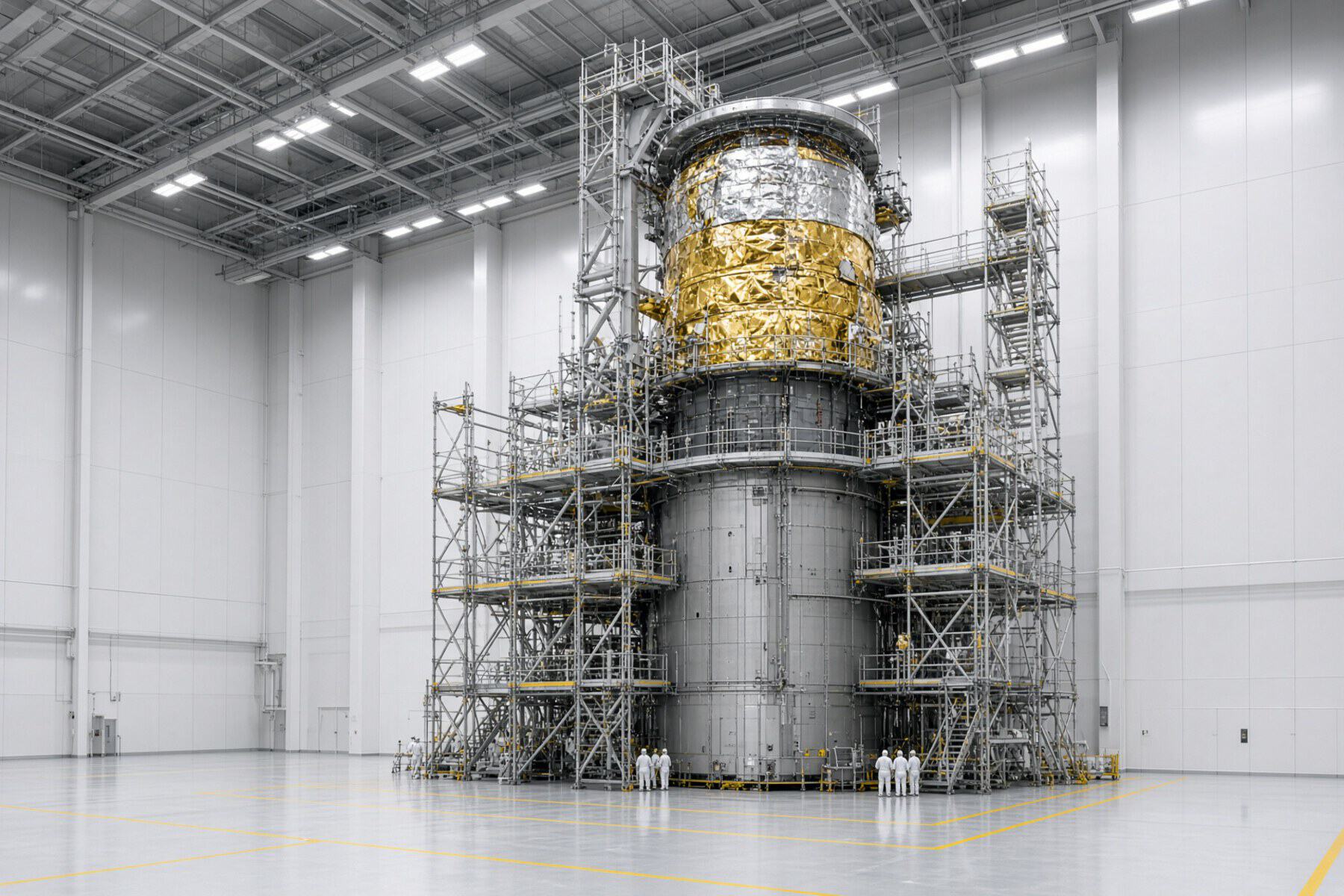
A tall cylindrical vehicle article standing in a white high bay, enclosed in grey and yellow access scaffolding. Its lower section is bare metal; the upper section is wrapped in gold and silver thermal blanketing. Five people in white coveralls stand at the base, small against it, on a pale floor marked with yellow keep-out lines.
Plate 2 — LB-1 hull article 2 in the high bay at the Aldern Works, Building 4, during the 2026 rehearsal of the orbital assembly sequence. The gold and silver blanketing covers the pressure hull section; the bare cylinder beneath it is the handling can, which does not fly. The five people at the base are the scale. Nothing in this photograph goes up as one piece — the vessel is assembled in orbit, from articles, and has no launch configuration at all.
FIG. 4 — LB-1 GENERAL ARRANGEMENT, PORT ELEVATIONREV. CSTA 0STA 12STA 41STA 68OVERALL 68.4 mSHIELDMASS142 tRADIATOR · 2 × 148 m²RADIATORPROPELLANTPRESSURE HULL · 6 BERTHS · 412 m³1.4 MWe
Fig. 4 — LB-1 general arrangement, port elevation, rev. C. Station numbering from the propulsion stage forward. Radiator area is sized for the reactor at full output with one panel lost.
Launch cadence

Tied to the transfer windows, which are not negotiable. Cargo precedes crew by two windows in every case. Nobody is sent to a site that does not already have power, water, shelter and a spare of each.

2027window 1
TDR-01Power plant, 1.4 MWe · 38.2 t
TDR-02Sinter works and pad plant · 31.7 t
TDR-03Consumables and spares cache · 26.4 t
2029window 2
TDR-04Habitat shell 1 · 44.1 t
TDR-05Habitat shell 2 · 44.1 t
TDR-06Water plant and stores · 29.8 t
LB-1 (U)Vessel, uncrewed shakedown transit
2031window 3
LB-1First crew of six · 258-day transit
TDR-07Habitat shell 3 and crop article · 41.6 t
2033window 4
LB-2Second crew of six · first return crew outbound relief
TDR-08Industrial plant, second phase · 36.9 t
2035window 5
LB-1Crew rotation three · continuous occupation begins
TDR-09Expansion shells 4–5 · 58.2 t

Flights marked with a dark rule carry crew. Transit 258 days nominal. None of this is a promise; it is a schedule, and the Foundation publishes the dates it misses in the same place as the dates it keeps.

Apply for a grant

Eight divisions, two award rounds a year, and a proposal form that asks for six pages and will not read a seventh. The Foundation funds the unphotographed part of a mission: seals, coatings, calibration targets, the second detector that proves the first one.

Awards carry one condition, and it is not negotiable: publication in full, without embargo, including negative results.

Research, grants and how to apply →

Support the mission

The Foundation is endowed, spends no money on fundraising, and has never run a campaign. This site cannot take a payment and does not ask for one.

What is genuinely useful to us is work, data and criticism — and telling somebody that the coatings library from 1959 is still open for anybody to read.

What actually helps →