- TDR-01Power plant, 1.4 MWe · 38.2 t
- TDR-02Sinter works and pad plant · 31.7 t
- TDR-03Consumables and spares cache · 26.4 t
Programme LONGBOAT · PRO · 2022 →
Longboat
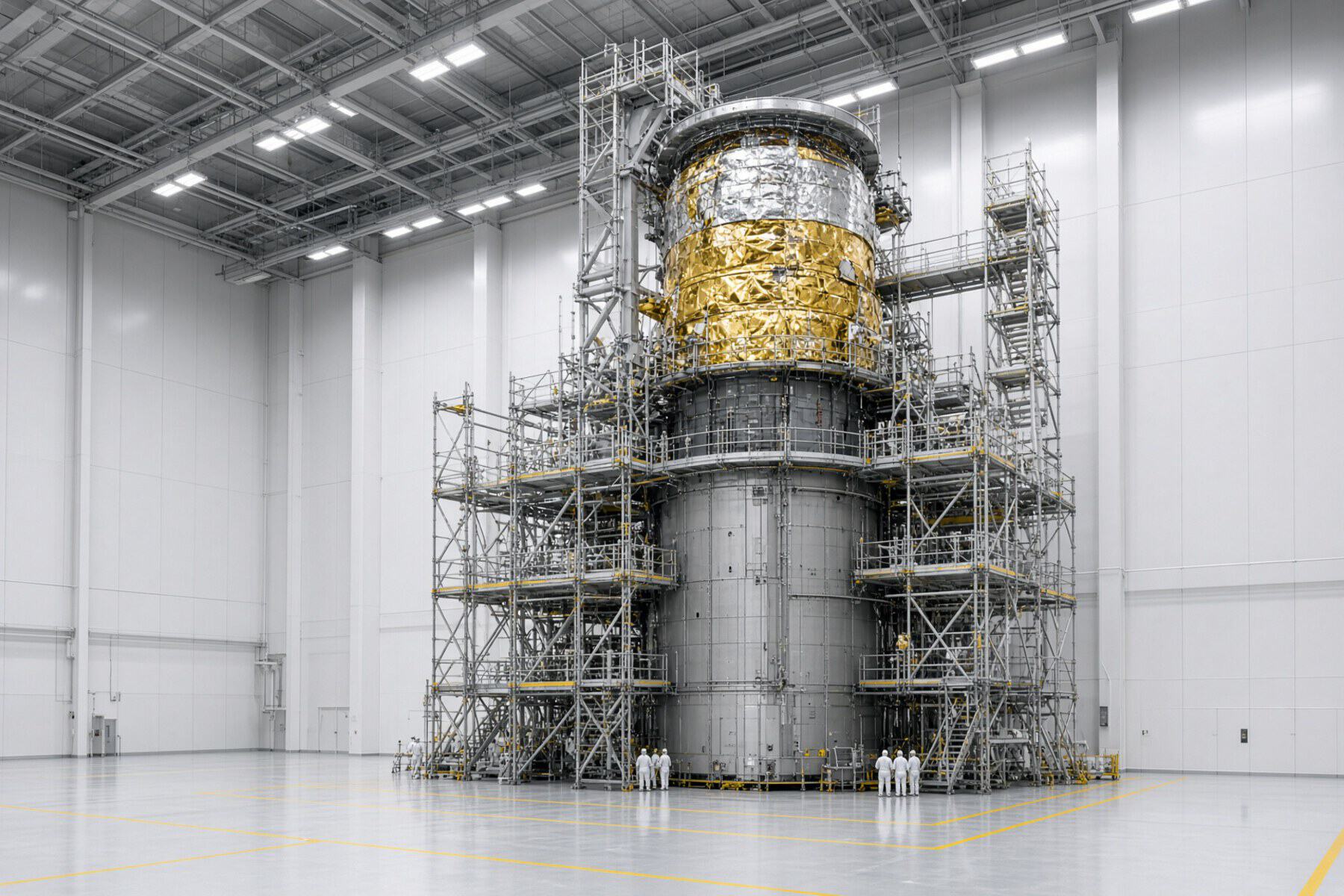
A transfer vessel assembled in orbit. It carries six people for 258 days and never touches either surface. It is not a rocket — it never lands, and it is never empty. It is also the only part of this programme we cannot buy from someone else.
Scroll68.4m
overall length of the vessel
142t
water stacked forward of the crew
258days
nominal transit, Earth to Mars
0.31Sv
measured crossing dose, 2013 figure
Why it is shaped like that
Shielding is a water problem
In 1962 Aurelio Banich wrote, in a note the Foundation did not yet exist to pay for, that the mass you bring to stop a proton is mass you were going to bring anyway if you choose it carefully. Water stops radiation, and the crew has to drink.
The argument was numeric by 1996 and measured in 2013 at 0.31 Sv for the crossing. 142 tonnes of water sits forward of the pressure hull, between the crew and the Sun, and is drawn down over the transit in the order that keeps that shadow deepest for longest.
Everything else about the vessel follows from two constraints: get rid of 1.4 MWe of waste heat, and never depend on a part that has not already flown without a crew.
| Designation | LB-1, LB-2 — programme LONGBOAT |
|---|---|
| Length overall | 68.4 m |
| Pressure hull | 412 m³ |
| Berths | 6 |
| Power | 1.4 MWe, reactor-electric |
| Heat rejection | 2 × 148 m² deployable radiators |
| Forward shield | 142 t water |
| Nominal transit | 258 days |
| Assembly | In orbit. The vessel never lands. |
| First uncrewed transit | 2029 window |
| First crewed transit | 2031 window |
Programme TENDER · PRO · 2023 →
Cargo goes first
Cargo precedes crew by two windows, without exception. By the time six people leave in 2031, the power plant has been running at Thessaly Bench for four years, two habitat shells are buried, and the water plant has already filled its first tank.
Launch cadence
Five windows, 2027 to 2035
Windows fall about 26 months apart. Miss one and the schedule does not slip by a month, it slips by a window.
- TDR-04Habitat shell 1 · 44.1 t
- TDR-05Habitat shell 2 · 44.1 t
- TDR-06Water plant and stores · 29.8 t
- LB-1 (U)Vessel, uncrewed shakedown transit
- LB-1 · crewedFirst crew of six · 258-day transit
- TDR-07Habitat shell 3 and crop article · 41.6 t
- LB-2 · crewedSecond crew of six · first return crew outbound relief
- TDR-08Industrial plant, second phase · 36.9 t
- LB-1 · crewedCrew rotation three · continuous occupation begins
- TDR-09Expansion shells 4–5 · 58.2 t
Manifest TDR-01 · extract
11,904 line items
That is what the first cargo flight carries. Line 9901 is the printed manifest itself, certified, in duplicate, at 11.8 kg. A station that cannot read its own inventory does not really have one.
| Line | Item | Qty | Unit | Cl. |
|---|---|---|---|---|
| 0001 | Power conversion assembly, primary | 1 | 4,180.0 kg | A |
| 0002 | Power conversion assembly, standby | 1 | 4,180.0 kg | A |
| 0114 | Radiator panel, deployable, 74 m² | 4 | 812.5 kg | A |
| 0396 | Cable, HV DC, 240 mm², reeled | 1,200 | 3.11 m | B |
| 0397 | Cable, HV DC, terminations, spare | 48 | 0.94 kg | B |
| 1042 | Sinter head, 1.2 kW, with spare emitter | 2 | 96.4 kg | A |
| 1043 | Sinter head, emitter, spare | 6 | 3.2 kg | C |
| 2711 | Seal, rotary, dust-rated, 60 mm | 240 | 0.08 kg | C |
| 2712 | Seal, rotary, dust-rated, 120 mm | 160 | 0.21 kg | C |
| 4188 | Calibration target, reflectance, set of nine | 3 | 1.40 kg | B |
| 7735 | Bearing, angular contact, spec MF/MAT/1958-A | 600 | 0.06 kg | C |
| 9901 | Manifest, printed, certified copy | 2 | 11.80 kg | A |